
Month: June 2018

  • Plant Angles

    Although the butterflies are the stars of the show in the Texas Discovery Gardens, they’re not the only interesting and beautiful things you’ll see there. There’s also a breathtaking array of different plant species, some of which you’re not likely to see in everyday life. There’s a wide enough range of species that you can go on a mission to uncover a secret that underlies many plants around the globe.

    Your mission, should you choose to accept it, is to measure the angle between successive leaves around the stalk of different plants. There are lots of different plants to try. To clarify the mission, you’re not looking for the angle between branches or between a leaf and a branch. Instead, you should try to look straight down the stalks of various plants, and measure the angle between the directions that two successive leaves stick out radially from the axis of the stalk. I’ve marked the different kinds of angles in these photos from the Center, so you can better see what is meant.

    When you’ve taken a number of measurements, what do you notice? Are any angles more common than others?

    You should observe that angles around 137 or 138 degrees are the most common. Why that number? Is there anything special about that angle?

    It turns out there is! What are the leaves there for? To catch sunlight for photosynthesis, which feeds the plant. Imagine that the angle between successive leaves was 90 degrees, a right angle. Then there would be just four orderly rows of leaves, stacked up right on top of each other, and they would block each other from the sun. So that would be an extremely bad angle. 90 degrees being bad suggests the question of whether there is a best angle, where the leaves on average overlap the least? And indeed there is. Using some geometry and other math, you can prove that there is an ideal, least-overlap angle, and that that angle is between 137 and 138 degrees. So the plants have naturally evolved to “discover” that ideal angle. This is a case of a basic mathematical principle dictating the structure of millions of life forms on earth. And the story gets even more interesting — it turns out that angle is closely related to the Fibonacci numbers (1,1,2,3,5,8,13, and so on, where each number is the sum of the previous two) and so can help explain why when you pick up a pineapple or sunflower or pinecone, there are usually a Fibonacci number of spirals to its seeds.

  • How Often Does a Butterfly Emerge?

    Before you get down to the butterfly nursery on the lower level of the Texas Discovery Gardens, let’s see if you can figure out, on average, how often a new butterfly emerges from its chrysalis.

    How might you go about that? Well, it would be useful to know that the average lifespan of a butterfly is about two weeks. How would that help? If we knew the number of butterflies in the room, we could reason that to keep the number of butterflies at that level, that many would have to emerge every two weeks, to replace the butterflies that would all die over the course of those two weeks. So we would just divide two weeks (or 14 days or 336 hours or 20,160 minutes) by that number to get the average interval between butterflies emerging.

    So that switches our question to how many butterflies are there in the room. At first, that might seem like an intractable problem. After all, the room is huge, and the butterflies are flitting everywhere. You could never count them one by one — they just won’t sit still! And how can you tell whether you’ve counted one already or not?

    So we need to use other mathematical tools. Rather than trying to get an exact count, we want to estimate. There are lots of ways to estimate. Here are a couple you might try. (1) Take a picture of the room and carefully count how many you see in the picture. Guess what fraction of the room is visible in the picture, and then multiply to get the number visible in the whole room. Then (here’s the most inaccurate part) guess what fraction of the butterflies are visible at any time — for example, by watching a section of the foliage for a while and seeing how many you see at first versus how many seem to turn up unexpectedly). Now multiply again to get the total number of butterflies in the room, both visible and hidden. (2) First estimate the volume of the room — maybe you can find the height, width, and length of the room from the staff. Then with your classmates, pick a well-defined section of the room that you can observe carefully and try to count how many butterflies in that section. Then measure the volume of that section. Finally multiply your count by the volume of the whole room divided by the size of that section. (3) Again, start with the volume of the room. Then estimate the average distance between a butterfly and its nearest neighbor butterfly. Pick a number of closest pairs of butterflies and do your best to measure the distance between them, using a measuring tape to compare. Include both butterflies whose nearest neighbor is close, and “loner” butterflies whose nearest neighbor is far away. When you have a bunch of measurements, average them. Finally, divide the volume of the room by the volume of a sphere whose radius is what you found for the average distance between butterflies. (Imagine the entire room filled with a spherical “bubble” around each butterfly!)

    When you have your estimate, do the division to guess how often a butterfly emerges from a chrysalis. When you get down to the nursery area, you can ask about your guess to see how close you’ve come!

  • Butterfly Shapes II

    Turning from the shape of a butterfly’s path through the air to the shape of the butterfly itself, what do you notice about the shapes of the creatures you see all around you in the air?

    First, it might strike you that there are so many different shapes! It seems as though every kind of butterfly is different. How can different butterflies produce such different shapes? It seems as though we ought to count the number of wings on different butterflies, because one way we might explain different shapes is by different numbers of wings.

    However, if you look carefully all the butterflies around you, you will discover that they all have exactly four wings. In fact, every type of butterfly in existence has four wings. So there must be some other way they achieve such shape variation.

    As you look at more butterflies, though, you will start to see certain patterns that recur, similarities among those differences. Can you find some examples?

    A first, and mathematically important one, is symmetry. If you imagine a line through the middle of any healthy butterfly, the left and right sides are identical, just one is flipped the other way from the first. That type of pattern is called mirror or bilateral symmetry, and you will see it over and over again in the natural world.

    There are other more detailed patterns in the shapes of butterfly wings. You may notice that they tend to be divided into sections by the veins in the wings, and those sections tend to have a similar arrangement in different types of butterflies. For example, you may notice that there tends to be an oval section in the middle of most wings, surrounded by fairly straight sections that proceed out to the edges of the wings.

    That basic structure allows you to notice some more things. For example, many types of butterflies have “tails,” or long protrusions on the back of the wings. And those tails generally seem to come from the third or fourth sections of the back wings being longer than on other butterflies that don’t have tails.

    And that observation provides an essential clue about the overall shape variation of butterfly wings: by changing the lengths of all of the different sections, the basic structure of a butterfly wing can produce thousands of different shapes. See if you can figure out the “instructions” for producing different butterfly wings, in terms of stretching or compressing different sections of the wing.

  • Butterfly Shapes I

    As you walk through the butterfly room of the Texas Discovery Gardens, take time to slow down and notice what’s going on in the space around you. What do you notice about the flight of the butterflies? I spent some time watching the different flight paths used by different butterflies. What shapes of paths in the air do you see?

    If you’re like me, you probably noticed that when a butterfly is flapping its wings, the path is usually very erratic, darting this way and that. But does a butterfly have to fly erratically? No, if you watch for a while, you can find times when they flay in more regular paths. So why would they fly so erratically?

    That question leads us to the topic of extrapolation. If you knew that someone had drawn a shape and erased part of it and what was left looked like this:
    how might you try to complete the shape? You would probably draw something like this:

    On the other hand, if what was left looked like this:
    you’d really have no idea how to complete the shape. It could turn out to be any of thousands of different paths.

    How does this relate to the butterfly’s flight? Well, who might want to figure out where the butterfly’s path will take it? Who would be interested in where the butterfly would end up? Maybe something that wanted to eat it? Butterflies are not big or strong, and they are easy to spot amidst the plants. So they need other defenses, and the erratic geometry of their flight is one: they make it very difficult for predators to extrapolate their paths and intersect with them to catch them. So mathematics can be useful, even to a butterfly!

    If you look at their non-erratic flight, you can also see another mathematically interesting shape. You’ll notice that sometimes they glide in straight lines, but that they also glide in curved paths. In these curved paths, they tend to go around in a circle when viewed from above, while also gradually descending. This kind of curve, that curves like a circle while descending (or ascending), has a special name in mathematics. It’s called a helix and it’s a shape we can see in many places around us: the handrail of a circular staircase, the thread of a screw, the rail of some roller coasters, and more. It’s also a kind of flight pattern that occurs spontaneously over and over: in nature, like the path of a spinning seed falling from a tree, or in man-made flying objects, as this illustration from the Federal Aviation Administration’s handbook for glider pilot’s shows.

  • Lazy Bees

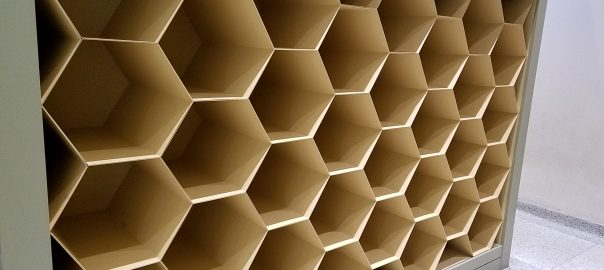
    In the foyer of the Texas Discovery Garden you will likely notice this wall of cubbies.

    What does it remind you of? A honeycomb, of course! But did it ever occur to you to wonder why bees build honeycombs in the shape they do? It turns out there is a simple mathematical reason that they do.

    To understand this, try the following activity. You need twelve short straight items, like matchsticks or pins — it doesn’t really matter what, as long as they are straight and all the same length. Print out this rectangle, scaled so the long side is exactly four times the length of your sticks. Now, try to lay your sticks flat in the rectangle, to satisfy the following three rules:

    1. Each end of each stick is touching one of the sides of the rectangle or the end of at least one other stick.
    2. The rectangle is divided into seven regions by the sticks.
    3. No region formed is less than half the area of any other region formed.

    You should work on it for a while before you look at the solution — it’s fun to try to come up with it on your own. But whether you discover it or you peek, one of the amazing facts about this puzzle is that there is only one way to do it, and in that one way, you must create a hexagon, two half-hexagons, and four three-quarter hexagons.

    The reason for that is that there’s not enough total length to your twelve sticks to divide the rectangle any other way, because it turns out that the most efficient way — the way that uses the least total length of line segments — to divide an area up into many equal-sized regions is to split it up into hexagonal shapes. In other words, over the course of evolution, honeybees have figured out the way to construct their honeycombs that requires the least wax and therefore the least work. That’s what the title of this post means — honeybees have found the unique way to do the least amount of work to build their hives, which you could maybe think is a little lazy, couldn’t you?

    And in fact, honeybees have done even better than I’ve mentioned so far. They build their hives in three dimensions, not two, and they make their honeycombs in double layers, so there are cells with openings on either side. If you look at how the bottoms of the cells are constructed, each consists of three small flat facets, and the facets of the cells from one side interlock perfectly with the facets from the other side. Mathematicians have determined that this configuration is also the most efficient way possible to construct a double layer of cells in three dimensions — something honeybees have “known” for millenia!