
In collaboration with talkSTEM, to take part in the upcoming Earth X conference at Dallas Fair Park, I designed a “mini” math tour of four stops at some of the highlights of the lovely architecture found there. Hopefully you can come to Earth X and take part yourself in seeing some of the beautiful buildings created for the 1936 World’s fair through a new, mathematical lens. The preceding four posts will give you a preview of the tour.
Month: March 2018
-
Towering Gold
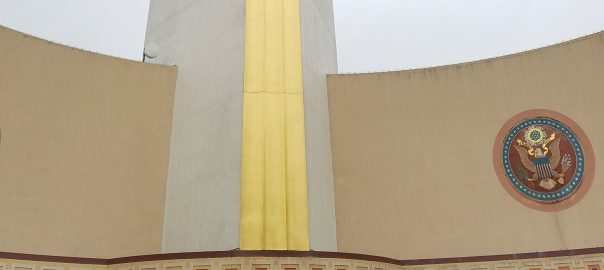
Perhaps the most eye-catching feature of Dallas Fair Park is the gold-leaf wrapped Tower Building.
Yes, that is real gold!Because of the allure and attraction of gold, our first math walk stop in Fair Park will be to ask, “How much is all of that gold on the Tower Building worth?” Before we go through the calculations, stop and take a moment to guess. Is it 1,000 dollars worth of gold if we crumpled it up into a solid nugget of gold? $10,000? A million dollars? Let’s figure it out.
Since gold leaf is gold spread out thinly over an area, we need to figure out the surface area of the building that is covered by gold. We will model the front of the tower as a giant rectangle, the front of the eagle as another rectangle (which is of course a rough approximation, but it’s a small percentage of the entire gold area), and each wing as another rectangle. So we just need the dimensions of each rectangle.
To estimate these dimensions, we can start with the height of the tower from the top of the frieze depicting the history of Texas to the feet of the eagle. We see that it is divided into nine vertical sections that appear to be equal in height. So we will focus on measuring the height of one of these sections, in particular, the bottommost section.
If you stand dead center in front of the building, you will notice as you walk toward the building or away from it that when you are very close to the building, the frieze section appears taller than the first gold section above it, but when you are very far from the building the gold section appears taller. Move back and forth until you get to a spot where the two sections appear to be exactly the same height (lining a pencil up at about arm’s length so that it appears to match one of the sections in height and moving it up and down to compare to the other section can help).
Once you’ve found such a spot, measure the distance to the center of the front wall of the building, and measure the height of the frieze directly with a measuring tape. (I get that the frieze is eleven feet high and that if I stand 22 feet away, the sections appear to be the same height.)
Now take a look at the following diagram — it’s a vertical cross-section of the situation where your eye is at the point marked “I.”
The fact that the two sections appear to be the same height means exactly that the two angles labeled theta are the same. Now with just the two dimensions and a little trigonometry, we can figure out the unknown height of the gold section. If you’ve learned some trigonometry, see if you can work it out.Here’s one way, in which we’ve cut the lower triangle in half with a horizontal line:

The angle theta/2 has to have tangent 5.5/22 feet, so it is about 14 degrees. Therefore, angle MIA is about 42 degrees, and so leg MA is 22 feet times the tangent of 42 degrees, or about 19.8 feet. Therefore, the gold section BA is 19.8 – 5.5 = 14.3 feet, which we will round to 15 feet for ease of calculation (and because our eyeballing and measuring was very approximate, and the architect was more likely to use round numbers of feet for key measurements of the building).
So the front section of the tower is roughly 9×15=135 feet tall, and we can directly measure how wide it is at the base. I got that it’s about 7 feet wide, but you should make your own measurement.
Now, what about that eagle? We’ll just guess that it’s the same height as one vertical section of the tower; that shouldn’t be too far off. So we’re modeling the front of the eagle as another 15 foot by 7 foot rectangle, and the wings as 15 feet high. So all that remains is the length of the wings, which is the horizontal dimension of the two sides of the tower.
But look closely at the sides of the tower.
You will see a faint rectangular grid, with that horizontal dimension three and a half boxes wide. Moreover, two of the boxes side by side appear to form a square! It’s like the builders wrapped the building in graph paper to help us. Therefore, the horizontal dimension we want is 3.5/2 times the height of one vertical section, or about 27 feet.Adding up all of the sections of gold, there are 135×7 + 15×7 + 15×27 + 15×27 = 1,860 square feet of gold leaf on the building.
How much gold does it take to make 1,860 square feet of gold leaf? Searching the internet, we can find one resource that tells us that 1000 “leaves” of gold cover 79 square feet and weigh up to 23 grams. Dividing, the 1,860 square feet we need to cover would need 1,860/79 or about 23.5 groups of 1,000 leaves, which would therefore weigh 23.5×23, or about 542 grams.
How much is that much gold worth, if it were crumpled up into one big nugget? To get that answer, we have to convert 542 grams into the unit that gold is bought and sold in: the troy ounce. A troy ounce consists of 31.1 grams, so the gold we’d need to cover the Tower Building would weigh 542/31.1, or approximately 17.43 troy ounces.
To finish off, as of the time of this writing gold has been trading in a range around $1,300 per troy ounce for the past year. Therefore, the raw value of the gold on the Tower building is about 17.43×1,300, or $23,000. Is that more or less than you guessed? If it’s less, then it’s probably because gold leaf is so incredibly thin. By comparison, enough household aluminum foil to cover the Tower Building would weigh about 6,700 grams, or over twelve times as much. Combining that with the fact that gold is over seven times more dense than aluminum tells us that gold leaf is almost 100 times thinner than aluminum foil — yet it’s strong enough to last centuries on the outside of buildings!
-
Sea of Blue (Tiles)
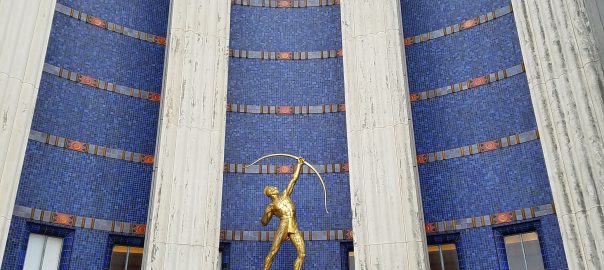
The facade of the Hall of State at Dallas Fair Park is awash in small blue tiles.
As such, it provides an excellent opportunity for a fun element of almost any math walk: A Really Big Number. In this case, how many tiles are there on the facade?To get a handle on this, we will take advantage of the fact that the tiles are in uniform horizontal rows. So we just need to estimate how many tiles in each row and how many rows there are in all, and then multiply.
For the first estimate, notice that the facade is shaped like a giant cylinder standing on its circular base; or rather, it’s a semi-cylinder, with horizontal rows of tiles along the semicircular arc of its perimeter. Go and stand where you think the center of that semicircular arc is.
The center of a semicircle is on its diameter, halfway between its endpoints where it meets the arc. So to find that position, you can count the flagstones horizontally between the two ends of the semicircular arc of the facade. There are 13 flagstones across, so the center is at the midpoint of the center (7th) flagstone.
But what we really want is the perimeter of that semicircle. Dividing the usual formula defining pi by two, we get that the length of a semicircle is pi times the radius of the semicircle (since the radius is half of the diameter). Measuring the flagstones, you will find that they are 40 inches across by 43 inches deep (toward the building). But now don’t be fooled! Even though there are six and a half flagstones from the center to the wall of the building on the left and right, that’s not the radius of the semicircle formed by a row of blue tiles — there is a balcony above the doors to the building, and the blue wall of tiles is behind that balcony. So don’t just multiply 40 inches by 6.5 to get the radius.
Instead, we will take the measurement from the center straight ahead to the inside doors of the building, which we can guess are directly below the blue wall of tiles (guessing that the compartment between the inner and outer doors on the ground level is the same depth as the balcony above, because architects like to line things up neatly). And that turns out to be six of the long dimensions of the flagstones, plus 38 inches for the last partial flagstone that lines things up with the building, plus eight feet to the inner doors, for a total of 6×43 + 38 + 96 = 392 inches.
Multiplying by pi, each row of tiles is approximately 1,232 inches long. Next, we need to know how big each tile is. Most likely, they are squares a whole number of inches on a side. So to get an idea of how many inches, take a look at how many tiles tall those windows on the second level are: about 24 tiles tall. So are the windows most likely to be two feet, four feet, or six feet tall? Our experience tells us that a two-foot window would be quite short and a six-foot window would be unusually tall (especially for a building built in 1936), so we conclude the tiles are two inches by two inches.
Therefore, dividing the perimeter of the semicircle by 2, there are approximately 616 tiles in one horizontal row. To count how many rows, note that the tiles are in seven groups vertically, and we can simply count that there are 30 rows of tiles in each group, for 210 rows in all. So, ignoring the tiles missing because of the windows, there are roughly 616×210 = 129,360 blue tiles on the front of the Hall of State!
-
Isosceles Esplanade
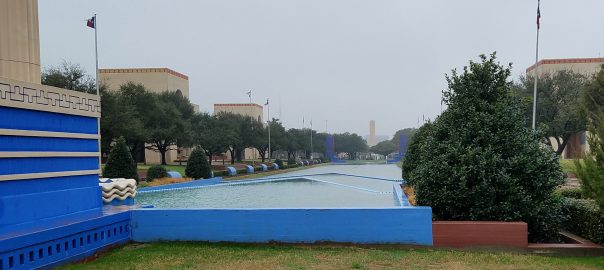
Perhaps your stroll around Dallas Fair Park brings you to the Esplanade, a stately reflecting pool between Centennial Hall and the Automotive Building.
The designers of the Esplanade for the 1936 World’s Fair had a difficulty, however: one end of the Esplanade is five to ten feet higher than the other, and of course water won’t stay with a slanted top; it always finds its level. So they had no choice but to install some retaining walls (in this case, two) between one end of the Esplanade and the other, dividing the pool into three separate sections. Water flows over one of the retaining walls, creating a pleasant cascade.Rather than choosing to build the walls straight across the Esplanade, the designers chose to angle the walls, creating two long, sharp triangles pointing away from one end of the Esplanade and leading the eye toward the fountain in the lowest section of the pool. Looking at these triangles, it looks very likely that the two sides of each triangle are the same length, making them a special kind of triangle called an isosceles triangle.
Looking at the resulting vista, one question that comes to mind is whether the engineers made the two triangles the same shape or not. The first thing to notice is that they can’t literally be identical shapes, because as you can see in the picture above, the nearer triangle is inset horizontally (along the shorter dimension of the pool) from the farther triangle. In other words, the base of the nearer triangle is shorter than the base of the farther triangle.
But when we talk about things being the “same shape,” we don’t usually mean that they are identical. For example, in the usual sense, all squares are the same shape, but there are certainly different sizes of squares.
Instead, what we usually mean when we say two things are the same shape is that you could scale one up to the size of the other and then the shapes would be identical. (The specific math word used for this is that the shapes are similar.) How can we tell if the two isosceles triangles in the Esplanade are similar?
A little geometry tells us that two isosceles triangles are similar if their vertex angles (in this case, the “pointy ends”) are equal. So if we had a giant protractor and could set it down on those two points, we could figure it out. But unfortunately, we don’t have a giant protractor, and those two points are stuck in the middle of the pool; there’s no way to get to them without taking a swim (and breaking Fair Park rules)!
To take a different approach, if those angles are equal, then the sides of the lower triangle will be parallel to the corresponding sides of the upper triangle. And in the photo above they do look parallel. So can we be sure? It looks pretty good even from another view:

However, to be really sure, we should go back to the very definition of “similar:” every dimension of the two shapes should be in the same proportion. To check this, we should pace out the “horizontal” (along the short side of the pool) and “vertical” (along the long side of the pool) dimensions of each of the two walls. If you take equal-sized steps, you can just count your steps along the edges of the pond from when you are opposite one end of the wall until you are opposite the other. To get the short dimension, where the far, pointy end of the triangles are blocked from view by the tower on the left of the pictures, remember that those points of the triangles are lined up with the center line of the pool (and don’t forget that the farther wall extends farther to the left and right of the tower than then near wall — make sure you’re lined up correctly when you are pacing them off).
When you have the two counts for each of the walls, divide the “vertical” count by the “horizontal” and see if you get the same quotient; that’s the definitive test of similarity. Give it a try!
-
The Big Wheel
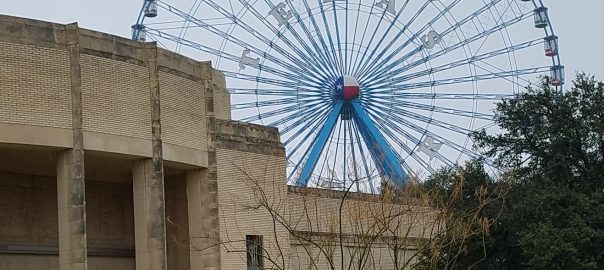
It’s hard to escape noticing the Texas Star Ferris Wheel towering over the landscape at the Dallas Fair park:
After all, it’s the largest Ferris wheel in the United States.As you’re watching it turn, there are lots of things you might wonder about, but if you’re like me, one of the first that comes to mind is: How fast is your gondola whisking through the air when you ride it?
To answer this question, we will go back to the venerable equation:
rate = distance / time
for which we will need to obtain a distance traveled and the time it takes to travel that distance. The obvious time to use is the time for one full revolution of the wheel. If the Texas Star is turning when you visit, then you can grab a stopwatch, choose one of the gondolas, start your timer just as it brushes the ground at the bottom of the wheel, follow it around with your eyes, and stop the time when it returns to the same location. If the wheel is still, you-ll have to rely on information found elsewhere on the web or on my timing — about 40 seconds for a full revolution.
How far does the gondola go in one revolution? Well, what path is it traveling along? It’s a circle, the characteristic shape of a Ferris wheel. So we need the perimeter of that circle, also known as its circumference, for which we can use another famous equation:
Circumference = π × diameter.
How to find the diameter of the wheel? If you can get up close to the Texas Star, you can start all the way at one side where the farthest-out bit of the wheel is just above your head, and count your paces (try to take equal-sized steps) walking alongside the wheel until the opposite side of the wheel is just above your head. Then with a measuring tape measure the length of ten of your paces (again, trying to use that same equal-sized step you used when pacing off the wheel). Divide the number of paces you counted by ten (hint: that’s easy to do by moving the decimal point one position to the left) and multiply by the length of ten paces.
If you can’t get close enough to the wheel for this method, then again you can rely on published information. According to a 2007 New York Times article, the diameter is approximately 212 feet.
Plugging in to the equation, the gondola travels about 666 feet in one revolution. So using the rate equation, that’s roughly 666/40 = 16.65 feet per second.
OK, that’s nice, but how fast is that? To get a better handle on the speed, we’d like to convert it into a more familiar unit, like miles per hour. To do that, we need to use some unit conversions, which we should write like fractions so that we can cancel:
(16.65
feet/second) x (1 mile/5280feet) x (3600seconds/hour) = 11.35…miles/hourSo the moral of this story is that when you’re riding the Texas Star, you’re traveling at just over 11 miles per hour — not quite as fast as you can ride your bike. On the other hand, it’s pretty hard to ride your bike 20 stories high into the air!