Another three quickies, this time about the iconic sculpture “Wave” by Santiago Calatrava.  (1) Is this sculpture curved or straight? (2) Is it symmetric? (3) How did Calatrava get each one of the copper beams to stay at the particular angle it sits at?
Again, it’s best to give participants time to chew on these questions and generate their thoughts. Then you can bring everyone together to see if there’s consensus. Here are my thoughts. (1) This sculpture is both curved and straight! It’s a remarkable fact that there are truly curved surfaces that can be broken up completely into a collection of individual straight lines. Such surfaces are called ruled surfaces, and they have been the subject of much mathematical study. This “wave” surface is one, and others include the elliptical hyperboloid and hyperbolic paraboloid shown below.
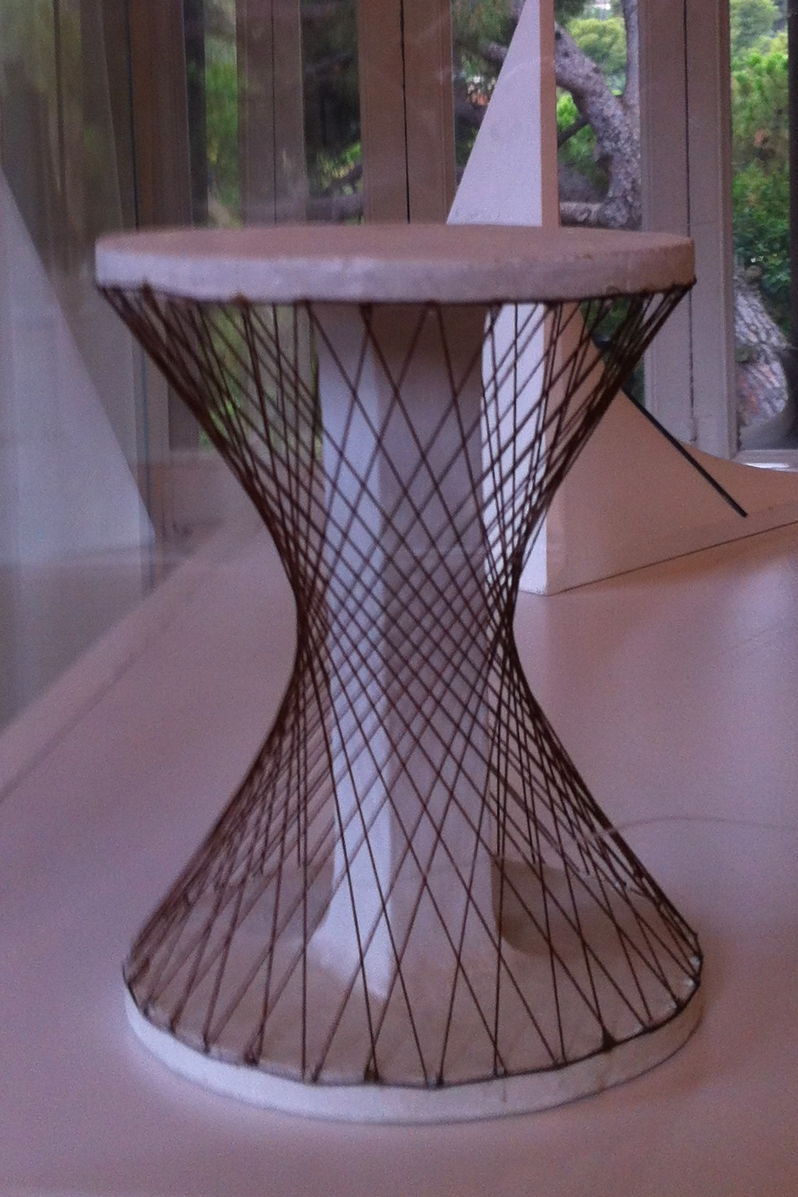

It is also very interesting that when a curved surface like this can be constructed from straight lines, it also has other straight lines that cross one such set of lines. That can be seen in Wave, as highlighted in the image below. (2) The question of the symmetry of the sculpture is a tantalizing one, becuase there is not a mirror symmetry along the central red line in the in the above picture (since a hump that is high on the left is low on the right and vice versa) nor is there a rotational symmetry around a vertical axis. But, since each individual line runs through the central red line, there is a 180-degree rotational symmetry about that axis, which brings every one of the beams back to coincide with itself.
(3) The secret to the different slopes of the different copper beams lies under the sculpture just to the left of the triangular support seen in the image above. If you peer under there, you will see a strut attaching to each beam, which otherwise can pivot at the central red line. Each of those struts is at a different height, and that height sets the slope of the corresponding beam. So as you peer under there, you will see the wave pattern of the entire sculpture replicated in those struts. In fact, there’s a mechanism inside the sculpture which allows each of those struts to move up and down, animating the entire sculpture.
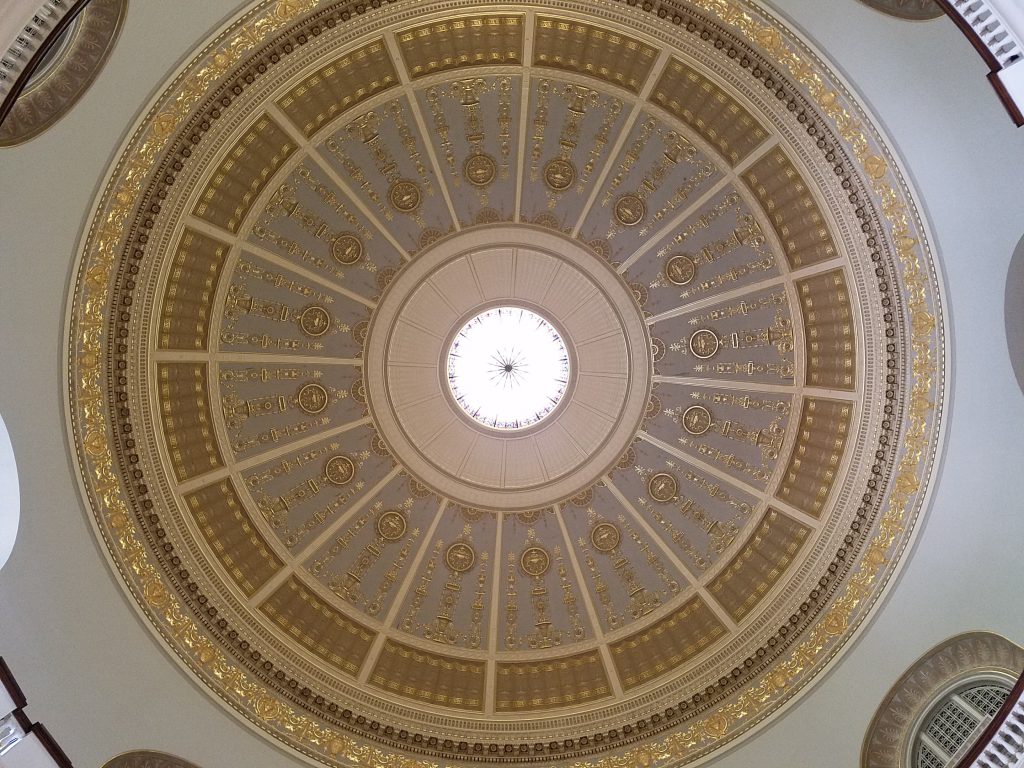 The entire structure has 16-fold rotational symmetry: if you stand at the center of the rotunda, look up at the dome, and then turn one-sixteenth of a full rotation, you will get exactly the same view of the dome. Not only is it beautiful (demonstrating, I think, an innate reaction to high symmetry), the structure of the dome allows you to count the elements in the decorations easily, because it sets up a linear relationship between the number of items in one section of the design and the number in the entire dome. So for example, to figure out how many brown scrolls there are around the entire domain, you count that there are seven in a single section, and then multiply by 16 to figure out that there are 112 scrolls in all. Or you can count the number of small carved rosettes near the edge of the design in one section, and multiply that number by 16 to get the total number of rosettes that had to be carved to decorate this dome.
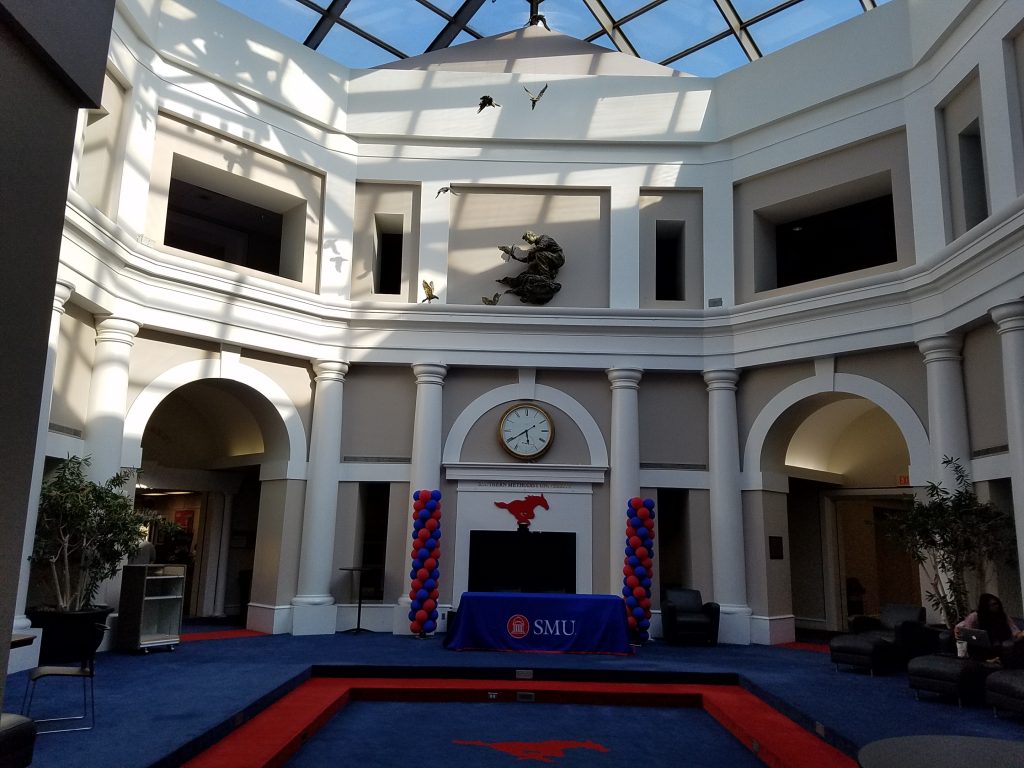 If you stand in the center of the room (right on top of the ubiquitous stallion), pick any direction and memorize what you see, and then turn ninety degrees, you will see an almost identical view. The arches, the moldings, the columns, the well in the center of the floor, the beams in the glass roof — all appear exactly the same when rotated a quarter turn. Only decorative details such as the sculpture of the boy with birds, or practical considerations like what you can see down each hallway, break the symmetry.
 If you imagine a vertical line running from the highest point of the building straight down through the center line of the doors and the center of the steps, you will see that virtually every element of the building on the left of that imaginary line is replicated identically, except flipped as if in a mirror, to the right of that vertical line. That replication goes for columns, windows, doors, railings, moldings, drainpipes, and more. It even goes so far as to dictate the placement of lightning rods, and to cause the leftmost and rightmost doors into the building to be hinged in opposite directions.
 In this detail, you can see that the revered SMU stallion logo maintains its universal run to the right on both sides of the main entrance doorway, instead of being reversed on the right-hand side to maintain the mirror symmetry. Overall, the Hughes-Trigg facade is an interesting study in the power of symmetry to shape the impression created by an image, and power of breaking that symmetry to emphasize a detail like the stallion.